


Sonny Rollins the legendary jazz saxophonist and composer, one of the most honoured and influential figures in American music of the 20th century and beyond, died yesterday afternoon [Monday May 25th 2026] at his home in Woodstock, New York. He was 95.
He is survived by his nephew Clifton Anderson and his nieces Vallyn Anderson and Gabrielle DeGroat. The announcement of his death today [May 26th] states “No public memorial is planned at this time”.
The short statement from his long-time friend and representative Terri Hinte includes this quote: “I think when the creative person ends, he continues in the next existence. I’m a person who believes this life isn’t the be-all and end-all of everything. A spiritual person doesn’t feel like that.” Sonny Rollins, 2009.
In 1958, he appeared in Art Kane’s famous photograph, “A Great Day in Harlem,” 57 notable jazz musicians on the steps of a tenement building in New York. Sonny was the only surviving musician from the photo after the death of Benny Golson in 2024 at 95, who was in the Tom Hanks film “The Terminal” as himself.
On Friday 25th November 2016, Sonny Rollins gave a 90 minute exclusive interview to this magazine, which we published in two parts: Part 1 on December 14th 2016 and Part 2 on January 17th 2017. Those interview features have notched up many thousands of hits from around the world; for what is a very revealing and fascinating retrospective on Sonny’s life and career in his own words.
It is fitting for us to offer up excerpts of that interview here, in respectful tribute to the pioneering saxophonist and jazz composer who was labelled “Saxophone Colossus”, which gives a vivid picture of who he was and what he achieved in his life. Sadly he was forced into retirement in 2012 due to a severe lung condition.
Speaking to me on the ‘phone from his Woodstock home outside of New York, at 11am US time, I open our chat reciting just some of the accolades that have been bestowed on him, from “legend”, “colossus” “giant” and many more. Sonny Rollins IS Jazz Royalty. How does that feel?
He laughs: “Well I never let it go to my head. I am always a musician that’s trying to get better, so I didn’t pay too much attention to it myself.” So how does he see himself in status and what he’s achieved?
“I don’t know. I have to let other people say if I’m important and what I’ve accomplished – if I’ve accomplished anything. I don’t want to say myself. I don’t think I should make my own judgement. That’s up to other people. Up to them and what they feel about it.”
Sadly, ill health forced early retirement on Sonny in 2012, when he gave his final performance. Boy, does he miss it. “Oh, I miss it tremendously. I had a health condition, a health issue, so I had to stop playing. I’m OK, but still not able to play.”
“I’m surviving other than that. I’m not able to blow my horn. I never realised how much energy it took to blow my horn, until I got a condition where I couldn’t blow my horn.
“It’s tremendously a problem for me (sic). I had to go through a lot in my life to be able to live without playing my horn. I played my horn 24/7 and that was all my life was about. Even my wife knew that; she’d say, ‘OK Sonny, your horn comes first and I come second. ‘I said OK,” he chuckles.
And this:
While it is sad the man cannot do what he loves doing above anything else; to blow his beloved saxophone, he has given so much and created a truly golden legacy. A gigantic reputation and a wonderful musical legacy, which no one can ever erase and which will live on forever.
“Oh, that’s very kind of you. I am very moved by you saying that. Thank you so much, thank you so much. The thing about me is that I always wanted to do more, and I’m sorry I wasn’t able to do more.
“Because I still have a lot of music going through my head every day. I’m still moving my fingers like I’m playing my saxophone, so I always wanted to do more. But, I’m happy that I’ve done what I’ve done and I’ve got through to some people, and I’ve left a helping sound (sic) for some people.”
And this:
Best moments of an eight decade career? “In my early days when I was playing with Bud Powell, playing with Miles Davis, playing with Thelonious Monk. Then playing with Clifford Brown the great trumpet player, Max Roach the drummer, Art Blakey the drummer, Elvin Jones the drummer.
“The battles I had with John Coltrane, with Dexter Gordon and Coleman Hawkins. The great time I had with playing with Lester Young. The way I can think back about that, is by thinking of the great people that I played with. And when I played with those people, that is when the great moments of my career come into it.”
And this:
The most surprising revelation in the 90 minute chat with Sonny, cropped up when I asked him about his work with The Rolling Stones. He played on three tracks on their 1981 album “Tattoo You,” but he was un-credited. Did it annoy him not being credited?
“I wanted to be un-credited. I did not want to be credited. I was ashamed to play with the Rolling Stones.” There is then 10 seconds of silence, before I ask; ‘really’? Sonny asks me: “Is that a shock?” Yeah it is. He laughs.
“Well, the Rolling Stones might be big to you, but to me the Rolling Stones were just some kind of a rock band from Europe. I didn’t have to be respectful…my wife made me do that record.
“I would not have done that record. I thought it was a come down for jazz, to be playing on some kind of an English rock and roll record. That was my thinking. I did not want to be credited, no, no.
“When that record came out, The Stones wanted me to do a tour with them, but I wouldn’t do it because I was ashamed. I’m Sonny Rollins. I’m supposed to be representing the top of jazz.
“Playing second fiddle to a British rock group didn’t make sense to me. I made the record for her and that was it. I’m not a fan of theirs and I do not know their work.” Well, Stone me! I do not think it hurt their career much; currently celebrating their 12th UK number one album for their blues filled, “Blue & Lonesome.”
And this:
So we arrive at THAT sensitive question: How does Sonny Rollins want to be remembered? He laughs. “It’s up to people. I don’t care. It is up to them how they remember me. I don’t know how they are going to remember me.
“I want to be remembered as a nice guy. ‘Oh yeah, I knew Sonny Rollins. He was a nice guy, he helped me do this’ That would be good, if it be true. Hopefully that is how they will remember me.”
I talk of the lovely photographs I have seen of him playing up on his bridge and on the beach. His voice trembles slightly. “Well that’s beautiful; because then I was in my heaven. I was in heaven when I was on the bridge playing, and at the ocean, playing up to the sky. I was in heaven.”
Words by Simon Redley [And the original interview in 2016]
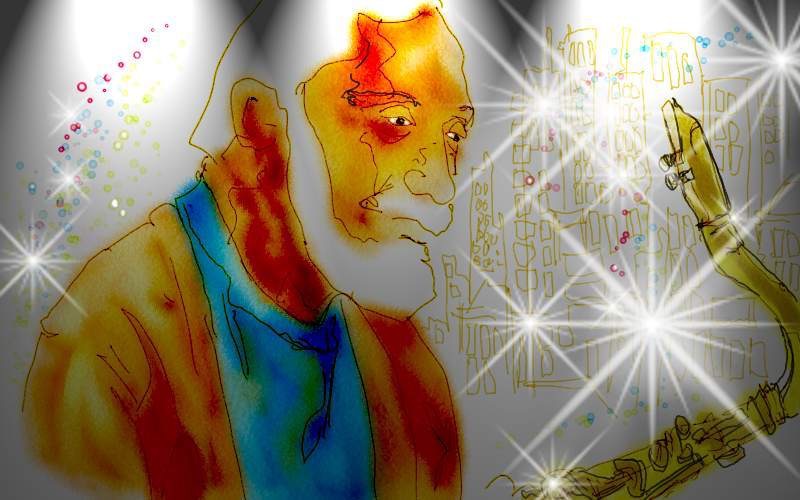
Sonny Rollins painting [top of page] Exclusively for this magazine: by Brian Travers










Recent Comments